
How to plan a europe trip on budget starts with one honest decision: pick what you care about most (cities, food, museums, beaches, nightlife), then cut ruthlessly everywhere else.
If you try to “do all of Europe” in one trip, you’ll usually overpay on transport, book bad-value hotels out of panic, and waste money fixing avoidable mistakes. A budget trip isn’t about suffering, it’s about choosing trade-offs on purpose.
This guide breaks down a practical planning flow that many U.S. travelers can actually follow, from timing and flight strategy to daily spending guardrails, plus a simple table to estimate costs before you book anything.

Start with a budget “shape” before you pick countries
Most people set a total dollar amount and hope it works out. More reliable is building a budget shape: fixed costs, variable costs, then a buffer for surprises.
Fixed costs usually include flights, intercity transport, and any non-refundable tickets. Variable costs cover lodging, food, local transit, and activities. The buffer is what keeps you from “budget panic” mid-trip.
- Choose a trip length that matches your spending style: longer trips can be cheaper per day, but only if you slow down and reduce transport.
- Decide your comfort floor: dorm bed, private room, basic hotel, or apartment. Lodging drives everything else.
- Set a daily cap (food + local transport + fun) and treat it like a rule, not a vibe.
Quick cost estimator (adjust to your style)
This table won’t be perfect, but it’s good enough to prevent expensive “guessing.” Prices vary by season and city, so use it to compare scenarios, not to predict exact totals.
| Cost category | How to estimate | Budget-friendly target |
|---|---|---|
| Flights (U.S. ↔ Europe) | Pick 2-3 gateway cities, track for 2-3 weeks | Buy when price feels “fair,” not perfect |
| Intercity transport | Count city-to-city moves, price trains/buses early | Fewer moves, more nights per stop |
| Lodging | Average nightly cost × nights + taxes/fees | Book cancellable early, re-check later |
| Daily spending | Food + local transit + attractions per day | One paid “anchor” per day, rest low-cost |
| Buffer | 10–20% of subtotal | Protect this for delays, price spikes |
Timing and destination choices that quietly save the most
When you go and where you land can matter more than any coupon. Shoulder season often gives the best mix: decent weather, fewer crowds, and lower prices than peak summer.
According to U.S. Department of State, Americans traveling to Europe should check entry requirements and travel advisories for each country, since rules and risk levels can change and impact routing and costs.
- Go shoulder season: late spring or early fall often keeps lodging and flights more manageable than July and August.
- Mix expensive + affordable regions: pairing, say, Switzerland with Northern Italy or Croatia can keep the average down.
- Limit “headline cities”: 2–3 big-ticket cities per trip is usually plenty if you want a budget to hold.
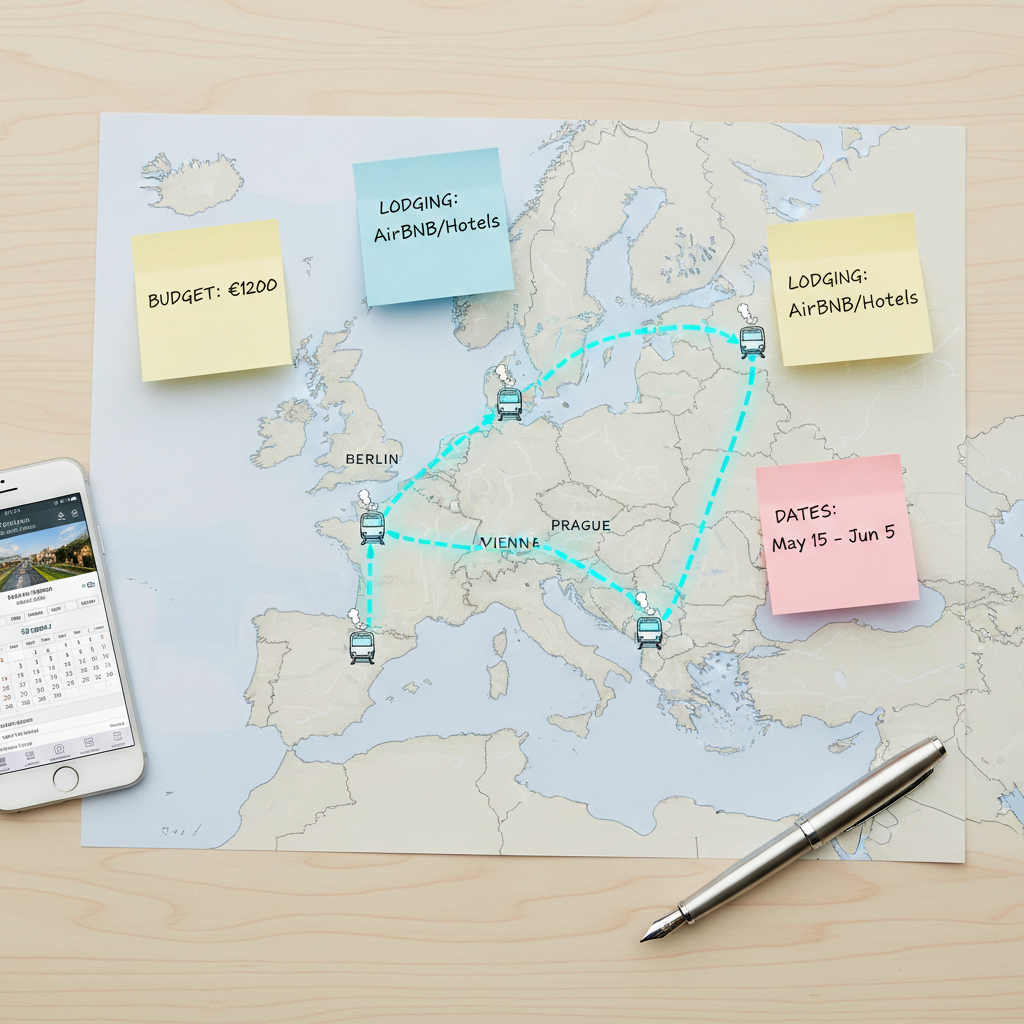
Flights: treat the Atlantic crossing like a separate project
If you’re serious about how to plan a europe trip on budget, don’t start by choosing the cutest itinerary. Start by finding a flight price you can live with, then build around it.
In practice, many U.S. travelers save by flying into one city and out of another, so you’re not paying to backtrack. This is often called an “open-jaw” itinerary.
- Check multiple gateways: London, Dublin, Paris, Amsterdam, Madrid, Lisbon can price very differently week to week.
- Stay flexible by 2–3 days: shifting departure or return can matter more than changing airlines.
- Watch total trip cost: a cheaper flight that forces pricey trains and hotels might lose overall.
- Pack to avoid fees: low-cost carriers (in Europe especially) can charge heavily for bags and seat choices.
Build an itinerary that reduces “movement tax”
The stealth budget killer is moving too often. Every time you change cities, you pay with transport, extra meals out, luggage hassles, and check-in timing that blocks your day.
A simple rule that works in many cases: aim for 3–5 nights per base, then use day trips. You’ll still see variety, but your costs stop bleeding.
Good budget routing patterns
- Hub-and-spoke: base in one city, take regional trains for day trips (often cheaper than switching hotels).
- One-country deep dive: fewer border crossings, simpler logistics, better chance to use regional passes.
- North-to-south line: a straight route reduces backtracking, especially when paired with open-jaw flights.
Lodging and food: save without making the trip miserable
Budget travel fails when it’s all sacrifice. You want “high comfort per dollar,” not the cheapest option that ruins your sleep and forces you to spend on fixes later.
For lodging, consider splitting strategies: a few nights in a central spot for walkability, then a quieter neighborhood with good transit for the rest.
- Book cancellable early, then re-check prices 2–3 times. This often beats waiting and hoping.
- Prioritize sleep and safety: a slightly better location can reduce taxi rides and stress.
- Look for kitchens or breakfast: even small food savings add up fast over 10–14 days.
Food is where people swing between extremes. A realistic budget approach: one memorable meal a day, then keep the other meals simple. Markets, bakeries, and casual counters usually do the job.

Local transport, passes, and attraction strategy (where plans pay off)
Once you’re in Europe, it’s easy to overspend on convenience. But it’s also easy to oversave by buying passes you don’t use. The win is matching tickets to your actual pace.
According to European Consumer Centres Network (ECC-Net), travelers should keep documentation and understand terms for tickets and services, since refund rights and conditions vary by provider and country.
Practical rules that tend to work
- Price single tickets vs passes based on your realistic sightseeing energy, not your aspirational plan.
- Stack free/low-cost attractions: parks, viewpoints, walking tours (tip-based), museums on free hours.
- Use contactless payments carefully: small charges add up, so glance at your daily totals.
- Don’t forget city taxes: some cities charge per-night tourist taxes that aren’t in the headline rate.
A simple 7-step action plan you can follow this week
If you want how to plan a europe trip on budget to feel doable, keep it boring and linear. This is the order that prevents most expensive detours.
- Step 1: Choose travel window (two options) and trip length.
- Step 2: Track flights to 2–4 gateway cities, pick the best-value deal.
- Step 3: Sketch a route with fewer moves, aim for 2–4 bases.
- Step 4: Reserve cancellable lodging in each base.
- Step 5: Price intercity trains/buses, book the key legs.
- Step 6: Create a daily spending guardrail and a buffer category.
- Step 7: Add 1–2 “splurge anchors,” then fill gaps with free/low-cost options.
Key point: booking early doesn’t mean committing early. Cancellable reservations give you leverage while you keep comparing.
Common mistakes that make “budget Europe” more expensive
This is the part people rarely admit: overspending is often a planning problem, not a willpower problem.
- Too many countries: border-hopping looks efficient on a map, but it raises transport costs and fatigue.
- Chasing rock-bottom flights: long layovers, awkward airports, bag fees, and extra hotel nights can erase savings.
- Ignoring the “last mile”: getting from airport to city late at night can force pricey transport choices.
- Overbuying passes: paying upfront for an aggressive sightseeing schedule you won’t keep.
- No buffer: one disruption can push you into expensive same-day bookings.
If safety concerns come up in a specific destination, it’s smart to adjust plans rather than forcing the cheapest option. In higher-risk situations, consider asking a qualified travel professional or reviewing official guidance.
Conclusion: budget planning is mostly about fewer decisions on the road
How to plan a europe trip on budget comes down to locking the big levers early, then keeping your daily choices simple: fewer city moves, flexible flight gateways, lodging you can cancel, and a spending cap you actually respect.
Your next move: pick your travel window and track flights for a week, then draft a 2–4 base route that avoids backtracking. Once those two pieces click, the rest gets noticeably easier.
Key takeaways
- Start with budget shape: fixed costs, daily costs, buffer.
- Slow down to spend less: longer stays beat constant movement.
- Plan one splurge per day: it keeps the trip joyful without blowing the total.
- Use cancellable bookings: it’s a practical hedge, not a luxury.
FAQ
- How far in advance should I book a budget Europe trip from the U.S.?
Many travelers start watching flights a few months out and book when the price feels reasonable for their window. Lodging with free cancellation often makes sense earlier, especially in popular cities.
- Is it cheaper to visit multiple countries or stay in one?
Staying in one country is often cheaper because you cut intercity transport and reduce check-in/check-out friction. Multi-country trips can still work if the route is linear and the moves are limited.
- What’s the cheapest way to get around Europe once I’m there?
Buses and slower trains can be very cost-effective, but time and comfort matter too. Many people mix options: train for core legs, bus for shorter hops, and walking/local transit within cities.
- Are rail passes worth it for budget travelers?
Sometimes, but not automatically. Passes tend to pay off when you take many long-distance rides in a short time, or when you value flexibility. If your itinerary has only a few major legs, point-to-point tickets may cost less.
- How can I save money on food without skipping local cuisine?
Try a “one highlight meal a day” approach, then use bakeries, markets, and casual counters for the rest. It’s a middle ground that still feels like traveling.
- Is travel insurance necessary for a budget Europe trip?
It depends on your risk tolerance and what you’re booking. If you have non-refundable flights or expensive reservations, insurance can be worth considering. For coverage specifics, it’s wise to read the policy details carefully or consult a licensed insurance professional.
If you’re working through dates, routes, and trade-offs and you’d rather not keep everything in your head, a simple approach is to build a one-page budget sheet plus a short list of “non-negotiables,” then plan the trip around those two anchors.